
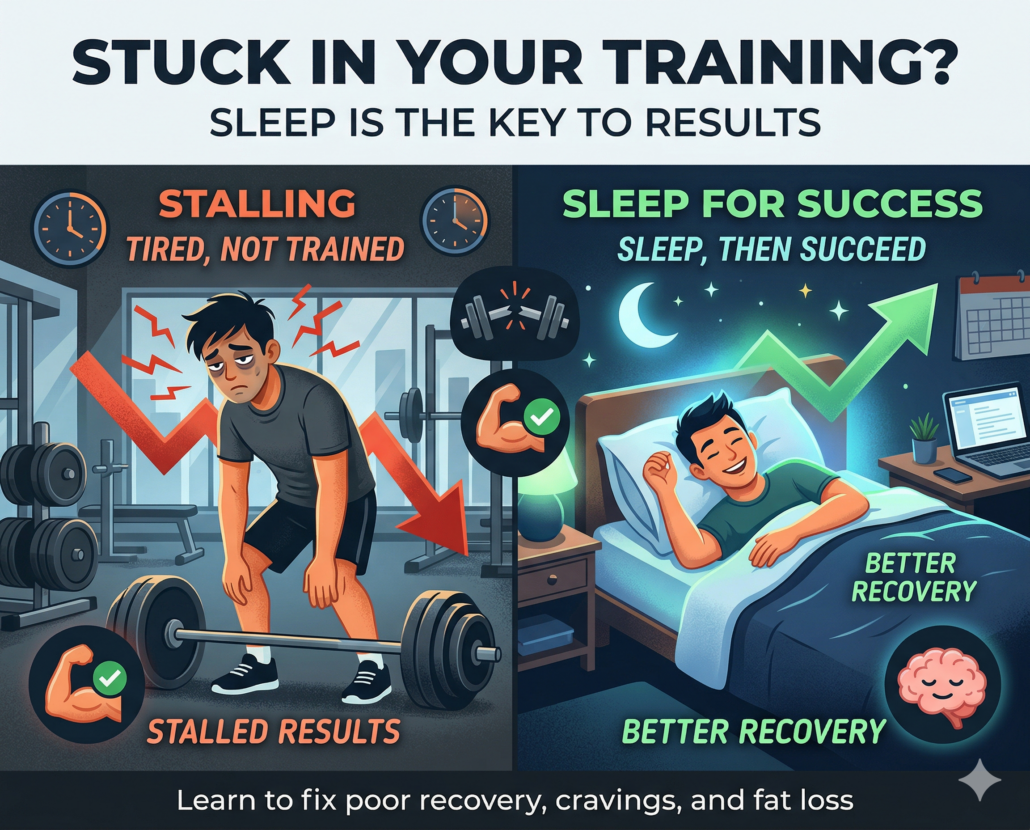
Sleep and Fat Loss: Why Poor Sleep Sabotages Your Training
You’re training three or four days a week. You’ve cleaned up your eating. The scale hasn’t moved in six weeks. Before you cut more calories or add another workout, ask yourself one question: how many hours of sleep did you get last night?
For adults 35–60 who train consistently, poor sleep is often the hidden reason progress stalls. It’s not dramatic. It’s not exciting. But the connection between sleep and fat loss is backed by decades of research — and ignoring it keeps more intermediate lifters stuck than almost any other factor.
The Sleep-Hormone Cascade That Wrecks Your Progress
When sleep drops below seven hours, your body starts working against you. Ghrelin — the hormone that signals hunger — rises. Leptin — the hormone that tells you you’re full — drops. The result is a double hit: you’re hungrier throughout the day, and it takes more food to feel satisfied. Willpower becomes nearly irrelevant when your hormones are pushing you toward the pantry.
This isn’t a minor effect. Studies show that even a few nights of restricted sleep can shift these hormones enough to add several hundred extra calories to your daily intake without you noticing. That’s enough to erase any calorie deficit you’ve worked to create.
Then there’s cortisol. Chronic stress — whether from work, life, or yes, under-recovery from training — keeps cortisol elevated. High cortisol drives cravings for calorie-dense, highly palatable foods. It also causes water retention, which can mask real fat loss on the scale and make you feel like nothing’s working. You might actually be losing fat, but the number staring back at you every morning tells a different story.
Why Sleep Deprivation Hits Your Training Harder After 35
Recovery slows as we age. That’s not a reason to stop training — it’s a reason to prioritise the factors that support recovery. Sleep is at the top of that list.
When you lift weights, you’re creating controlled damage to muscle fibres. The repair and growth happen during rest, particularly during deep sleep. Growth hormone release peaks during the first half of the night. Cut your sleep short, and you’re cutting into the window where your body actually adapts to training.
Research on sleep-deprived athletes shows measurable drops in strength, power output, and reaction time. For the average person training for body composition, this means your workouts feel harder, you can’t push as much weight, and your muscles don’t recover as well between sessions. Over weeks and months, that adds up to slower progress — or none at all.
Adults over 35 also tend to have more competing demands on their time and attention. Work stress, family responsibilities, and the general accumulation of life’s pressures all chip away at sleep quality. If you’re wondering why training felt easier at 28, part of the answer is that you probably slept better then.
Practical Fixes That Actually Work
The good news: improving sleep doesn’t require a complete lifestyle overhaul. A few targeted changes can restart progress without touching your diet or training program.
- Lock in consistent sleep and wake times. Your body runs on a circadian rhythm. Going to bed at 10 p.m. on weeknights and midnight on weekends confuses that rhythm. Pick a realistic bedtime and wake time, then stick to them seven days a week — even on weekends. This alone often improves sleep quality within a week or two.
- Get morning light exposure. Natural light in the first hour after waking helps set your circadian clock. In Edmonton winters, this might mean a light therapy lamp or a walk outside at lunch. The signal you’re sending your brain: it’s daytime now, which makes it easier to feel tired at night.
- Create an evening wind-down routine. Screens, bright lights, and stimulating activities close to bedtime keep your brain in alert mode. Thirty to sixty minutes before bed, dim the lights, put away your phone, and do something low-key — reading, stretching, or just sitting. It sounds simple because it is. It works because it cues your nervous system that sleep is coming.
- Watch caffeine timing. Caffeine has a half-life of about five to six hours. That afternoon coffee at 3 p.m. is still in your system at 9 p.m. If sleep is a struggle, cut off caffeine by noon and see what happens.
These aren’t complicated interventions. They’re also not optional if you want to keep making progress into your forties, fifties, and beyond.
The Bottom Line
If you’ve been stuck in a plateau despite doing “everything right” with training and nutrition, sleep is the first place to look. The hormone disruptions from poor sleep — elevated ghrelin, suppressed leptin, chronic cortisol — create a physiological environment where fat loss becomes genuinely harder. Add in the recovery demands of strength training, and sleep deprivation hits adults 35–60 especially hard.
You don’t need to become obsessive about it. Seven to eight hours, consistent timing, and a few habits that support your circadian rhythm will cover most of the bases. Sometimes the most effective change isn’t in the gym at all — it’s what happens when the lights go out.
If you’re dealing with stalled progress and suspect sleep, stress, or recovery is the missing piece, the Look Good Feel Good (Naked!) Coaching Program is built to address exactly this. It’s a structured fat loss program that looks at the full picture — training, nutrition, and the lifestyle factors like sleep that most programs ignore.
Interested In Being A Client?
Click Here to fill out a new client application form.

