
A Personal Trainer of 13 Years Reads the New ACSM Position Stand — Here’s What Actually Matters
Mar 31/2026, by Michael Fouts
Read time: 6-8 minutes
Every few years, something comes across my desk that genuinely makes me stop and pay attention. In March 2026, the American College of Sports Medicine (ACSM) published what is arguably the most comprehensive summary of resistance training research ever produced. It’s called a Position Stand — an official evidence-based statement — and it synthesised 137 systematic reviews covering more than 30,000 participants.
In 13 years of working as a personal trainer, I’ve seen plenty of research come and go. Some of it changes how I coach. Most of it confirms what good trainers already do. This one does both — and it also clears up a lot of noise that I think is genuinely holding beginners back.
This isn’t a summary of the paper. There are plenty of those online. This is my honest read of what it actually means for someone who are just getting started, or who have been stuck in the “I need to find the perfect program” loop for months (or years).
First: What Is This Paper, and Why Does It Matter?
Most fitness studies you see shared on social media involve a few dozen people over eight weeks. That’s not a knock on those studies — they serve a purpose — but they’re a single data point.
What the ACSM produced here is an “overview of reviews” — sometimes called an umbrella review. Instead of looking at individual studies, it synthesised 137 systematic reviews, each of which had already pooled data from multiple randomised trials. That layering of evidence is about as close as sports science gets to a definitive answer.
It also updates the previous ACSM Position Stand from 2009, which had been criticised for lacking rigorous evidence-based methodology. This version used contemporary search and grading methods, and the authors were transparent about where the evidence was strong versus where it was still unclear.
That transparency is actually one of the things I respect most about it. It doesn’t overstate. And that’s important context for everything I’m about to tell you.
What the Evidence Actually Confirms for Beginners
Let’s start with the good news, because there is a lot of it.
Compared to doing no exercise at all, resistance training significantly improved every major outcome measured: muscle strength, muscle size, power, endurance, balance, gait speed, and multiple markers of physical function. That finding held across age groups, training backgrounds, and equipment types.
The practical prescription that came out of the evidence for healthy adults:
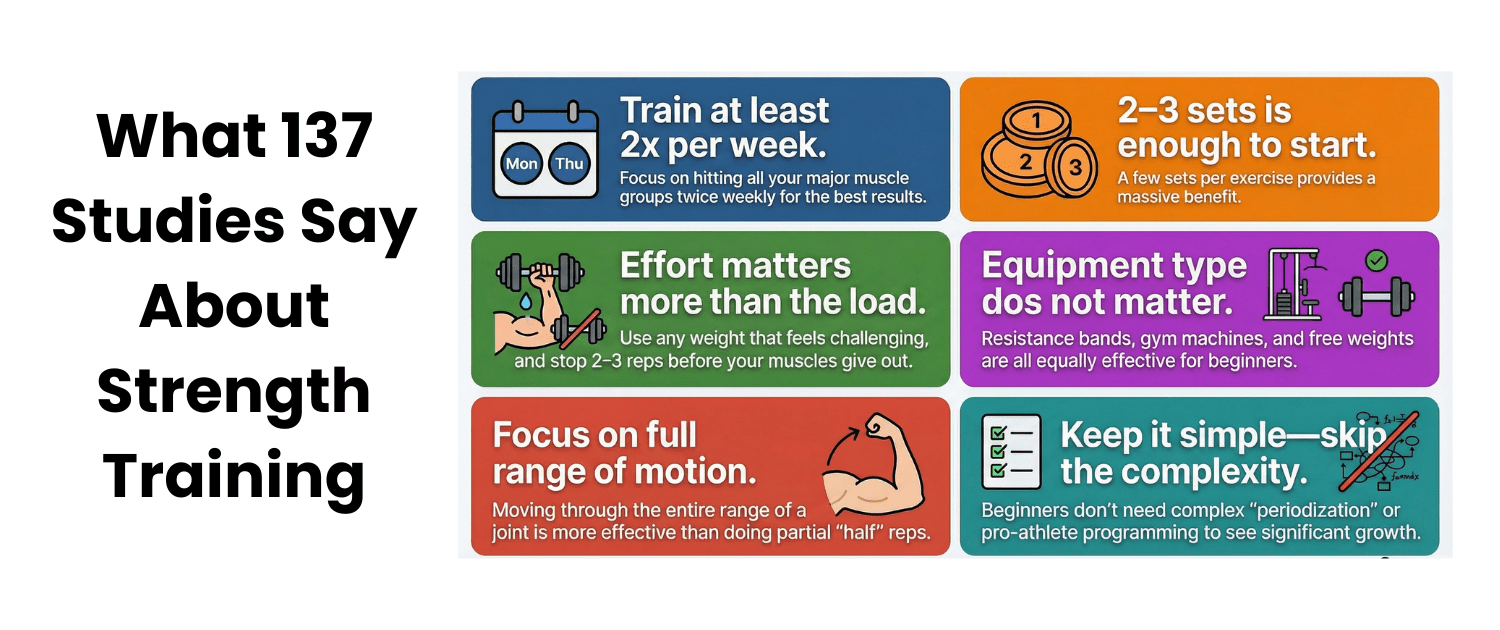
- Train at least twice per week
- Do 2–3 sets per exercise
- Aim for around 10 sets per muscle group per week for building muscle (hypertrophy)
- Use heavier loads (≥80% of your 1-rep max) if strength is your primary goal
- Work through a full range of motion
That’s it. That’s the foundation. For a beginner who has been agonising over which program is optimal, that list should feel like a breath of fresh air.
I’ve had clients come to me after months of researching — reading Reddit threads, watching hours of YouTube, buying programs they never started — because they were convinced they needed to get it exactly right before they began. The ACSM just used 30,000 people worth of data to tell you: two sessions a week, a handful of compound movements, 2–3 sets each. That is the program.
The Nuance That the Headlines Are Getting Wrong
Here’s where I want to slow down, because the way some of these findings are being communicated online is doing beginners a disservice.
“Equipment doesn’t matter” — sort of
The paper found no consistent difference between free weights and machines for strength or hypertrophy — when volume was equated. That last part is doing a lot of work in that sentence. The studies that compared the two kept the total sets, reps, and load matched. Under those conditions, the implement didn’t change the outcome much.
The finding about resistance bands and home training is slightly different. Those comparisons were mostly “did this produce gains versus doing nothing?” — and the answer was yes. That’s genuinely encouraging, and important for accessibility. But it’s not a direct head-to-head with barbell training under matched conditions.
My take as a trainer: use whatever equipment you will actually use consistently. The best equipment is the equipment you show up to. If bands at home get you training three times a week when a gym membership doesn’t, use the bands. The research supports that choice.
“Rest periods and tempo don’t matter” — when everything else is held constant
This one is being misread more than any other finding in the paper. The headline is: rest interval length, rep tempo, and time under tension did not consistently impact outcomes. And that’s true — within the studies reviewed.
But the critical variable being held constant in those comparisons was effort and total volume. When researchers equate sets, reps, and proximity to failure between a 30-second rest group and a 3-minute rest group, they’re essentially forcing both groups to do the same work — which means the short-rest group is working harder to achieve the same output.
In the real world, shorter rest periods often mean your second and third sets involve fewer reps or lower quality movement. Rest period length matters because it enables the volume and effort that actually drive adaptation. The rest itself isn’t the active ingredient — but inadequate rest can quietly rob you of the volume you need.
Practical guideline: rest long enough to perform your next set well. For most beginners, that’s 90 seconds to 2 minutes between sets. You don’t need to time it obsessively, but don’t rush either.
Training to failure is not required — and may work against you early on
The paper was unusually direct here: training to momentary muscular failure did not enhance strength, hypertrophy, or power compared to stopping short of failure. The recommendation that emerged was to leave roughly 2–3 repetitions in reserve — meaning you could have done 2 or 3 more reps, but you stopped.
For older adults specifically, the authors flagged that training to failure may actually be inadvisable. Form tends to break down in those final reps, and the injury risk — particularly from vascular strain — rises without a corresponding benefit in adaptation.
I’ve seen this play out many times. A new client comes in, determined to go all-out on every set because that’s what they’ve seen online. Two weeks later they’re dealing with elbow tendinitis or lower back soreness, and we’re spending sessions trying to get them back to baseline instead of building. Stopping 2–3 reps short isn’t a lack of effort, It’s intelligent training – and is something I agree with.
Periodization matters less than previously thought
The 2009 ACSM Position Stand placed considerable emphasis on periodization — the systematic manipulation of training variables like load, volume, and frequency across a program. The 2026 update walks that back meaningfully.
When volume is equated, periodized programs were not significantly superior to non-periodized programs for healthy adults. One review found a slight edge for periodization in strength gains, but it was modest.
For a beginner, this means you do not need to spend time worrying about linear vs. undulating periodization, deload weeks, or mesocycle structure. Those are tools for experienced trainees optimising for advanced gains. For the first 6–12 months, consistent progressive effort — gradually doing a bit more over time — is the entire program.
One Finding Worth Paying Attention To: Strength and Hypertrophy Have Different Load Requirements
This distinction gets glossed over in most summaries, but it’s practically important.
For hypertrophy (building muscle size), load across a wide range — from about 30% to 100% of your one-rep max — produced similar results, provided effort was sufficient. This means you can build muscle with lighter weights as long as you’re working hard enough.
For strength (the ability to lift heavy), heavier loads (≥80% of 1RM) showed a clear advantage. This makes physiological sense — strength is partly a neural adaptation, and your nervous system needs to practice producing force against heavy resistance.
For most beginners, I’d suggest not getting too caught up in this distinction early. Your strength and your muscle will both improve significantly in the first several months regardless of where your load lands — novice gains are relatively forgiving. But if your goal is specifically to get stronger, don’t spend all your time in the 15–20 rep range. Get comfortable under heavier loads progressively.
What This Actually Means If You’re Just Getting Started
Here is what I would tell a brand-new client sitting across from me after reading this paper:
Pick 4–6 compound movements that cover the major patterns — a squat, a hinge, a push, a pull, and a carry or core movement. Do 2–3 sets of each, 2–3 times per week. Leave a couple of reps in the tank on every set. Add a bit of weight or a rep or two every week or two. Do that for six months.
That’s not a dumbed-down version of a real program. That IS the program. The ACSM just used the most comprehensive dataset ever assembled on this topic to confirm it.
The paper also made a point that I want to highlight because I think it’s underappreciated: they argued that individualising programs to increase participation is more important than conforming to specific prescription criteria. In other words, the program you will actually do consistently is better than the optimal program you won’t.
If you train better at 6am, train at 6am. If you prefer machines to free weights, use machines. If three days a week is sustainable but four isn’t, train three days. The evidence supports all of those choices.
What the Paper Validated — and What It Didn’t Fully Settle
After 13 years of coaching, most of this paper felt like confirmation rather than revelation. The fundamentals that good trainers have been teaching for years — consistency, progressive overload, compound movements, adequate effort without grinding yourself to failure — are exactly what the evidence supports at scale.
What the paper was honest about not settling: the ideal number of sets beyond the 2–3 minimum, the precise role of eccentric loading for most people, and optimal programming for advanced trainees. These are areas where more specific research is still developing.
For a beginner, none of those open questions matter yet. You’re nowhere near the ceiling where fine-tuning those variables makes a meaningful difference. Your job right now is to build the habit, learn the movements, and accumulate consistent training weeks.
Ready to Start? Here’s a Simple Way to Do It
If you want a straightforward starting point that aligns with everything covered in this post, I put together a free beginner strength training template for exactly this purpose. It’s built around the evidence — compound movements, appropriate volume, progressive overload built in — without any unnecessary complexity.
Access it here: https://overhaulfitness.ca/overhaul-beginner-template.html
The science is clearer than it’s ever been. The only thing left is to start.
Related Posts:
 https://overhaulfitness.ca/wp-content/uploads/2026/05/banana_20260519_132326_487201-scaled.jpg
1143
2048
Michael Fouts
https://overhaulfitness.ca/wp-content/uploads/2022/09/Screen-Shot-2022-09-01-at-9.56.35-AM.png
Michael Fouts2026-05-26 17:20:522026-05-26 17:20:574 Reasons You’re Not Getting Stronger (And How to Fix Each One)
https://overhaulfitness.ca/wp-content/uploads/2026/05/banana_20260519_132326_487201-scaled.jpg
1143
2048
Michael Fouts
https://overhaulfitness.ca/wp-content/uploads/2022/09/Screen-Shot-2022-09-01-at-9.56.35-AM.png
Michael Fouts2026-05-26 17:20:522026-05-26 17:20:574 Reasons You’re Not Getting Stronger (And How to Fix Each One) https://overhaulfitness.ca/wp-content/uploads/2026/05/banana_20260513_101330_116665-scaled.jpg
1143
2048
Michael Fouts
https://overhaulfitness.ca/wp-content/uploads/2022/09/Screen-Shot-2022-09-01-at-9.56.35-AM.png
Michael Fouts2026-05-13 20:05:112026-05-13 20:05:11Zone 2 Cardio: How to Build It Into Your Training Program
https://overhaulfitness.ca/wp-content/uploads/2026/05/banana_20260513_101330_116665-scaled.jpg
1143
2048
Michael Fouts
https://overhaulfitness.ca/wp-content/uploads/2022/09/Screen-Shot-2022-09-01-at-9.56.35-AM.png
Michael Fouts2026-05-13 20:05:112026-05-13 20:05:11Zone 2 Cardio: How to Build It Into Your Training Program https://overhaulfitness.ca/wp-content/uploads/2026/05/banana_20260508_064020_690763-scaled.jpg
1143
2048
Michael Fouts
https://overhaulfitness.ca/wp-content/uploads/2022/09/Screen-Shot-2022-09-01-at-9.56.35-AM.png
Michael Fouts2026-05-09 10:57:292026-05-09 10:57:29What Is Hybrid Training? The 2026 Workout Style Explained
https://overhaulfitness.ca/wp-content/uploads/2026/05/banana_20260508_064020_690763-scaled.jpg
1143
2048
Michael Fouts
https://overhaulfitness.ca/wp-content/uploads/2022/09/Screen-Shot-2022-09-01-at-9.56.35-AM.png
Michael Fouts2026-05-09 10:57:292026-05-09 10:57:29What Is Hybrid Training? The 2026 Workout Style Explained
