
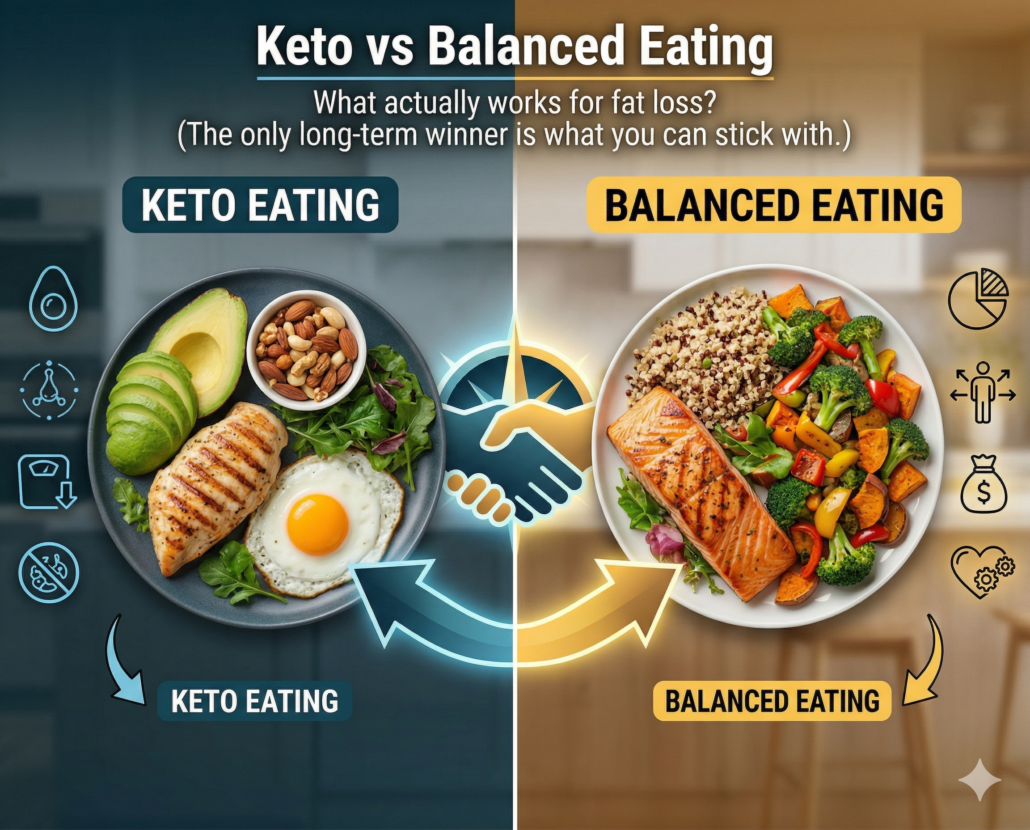
Every January, the same debate floods your social media feed: should you go keto or stick with balanced eating for fat loss? One promises rapid results through carb elimination. The other seems less exciting but claims to deliver lasting change. After years of watching clients try both approaches, I can tell you the answer isn’t about which diet burns fat faster — it’s about which one you’ll still be following in six months.
The Real Science Behind Keto vs Balanced Eating
Let’s cut through the marketing and look at what actually happens when you compare keto vs balanced eating for fat loss. Ketogenic diets restrict carbohydrates to roughly 20–50 grams per day, forcing your body to burn fat for fuel instead of glucose. This metabolic shift — called ketosis — sounds impressive, and it does produce rapid initial weight loss.
Here’s what the fine print doesn’t mention: most of that early drop is water weight. When you deplete your glycogen stores (your body’s carbohydrate reserves), you also release the water bound to that glycogen. You might see 3–5 pounds disappear in the first week, but it’s not the fat loss you’re hoping for.
Balanced eating — built around adequate protein, quality carbohydrates, healthy fats, and fibre-rich foods — produces slower initial results. But when researchers compare the two approaches over 12 months or longer, the fat loss differences essentially disappear. What matters is the calorie deficit, not whether those calories come from bread or bacon.
Why Most Keto Dieters Eventually Quit
The keto vs balanced eating debate often ignores the most important variable: adherence. A diet only works if you can actually follow it, and keto has a significant dropout problem.
Consider what strict keto eliminates: fruit, most vegetables, grains, beans, and essentially every food at social gatherings. Birthday cake at your kid’s party? Off limits. Thanksgiving dinner with your family? Navigate around the stuffing, potatoes, and pie. After-work drinks with colleagues? Hope they serve something besides beer.
Research consistently shows that restrictive diets fail not because they don’t work physiologically, but because they don’t work practically. A 2020 meta-analysis in the British Medical Journal found that while low-carb diets produced greater weight loss at six months, most of that advantage disappeared by 12 months as adherence declined.
For adults aged 35–60 juggling careers, families, and social obligations, sustainability matters more than speed. The best fat loss diet is the one you can maintain without dreading every dinner invitation.
Building a Balanced Approach That Actually Lasts
If you’re ready to skip the keto vs balanced eating debate entirely, here’s a practical framework for sustainable fat loss:
- Prioritise protein at every meal. Aim for 1.6–2.2 grams per kilogram of body weight daily. Protein preserves muscle during fat loss, keeps you fuller longer, and has the highest thermic effect of any macronutrient — meaning you burn more calories just digesting it.
- Build meals around fibre-rich foods. Vegetables, fruits, legumes, and whole grains add volume to your plate without excessive calories. Fibre also slows digestion, stabilising blood sugar and reducing cravings.
- Include carbohydrates strategically. If you train regularly — and you should be training if fat loss is your goal — carbohydrates fuel your workouts and support recovery. Place more of your daily carbs around exercise sessions.
- Don’t fear dietary fat. Healthy fats from sources like olive oil, avocados, nuts, and fatty fish support hormone function and help you absorb fat-soluble vitamins. Just remember that fat is calorie-dense, so portion awareness matters.
- Create a moderate calorie deficit. Aim for 300–500 calories below maintenance. Aggressive deficits lead to muscle loss, metabolic adaptation, and the kind of hunger that derails long-term success.
This approach builds skills that transfer into real life. There are no forbidden foods to obsess over, no dramatic rebound when you eat a piece of bread at a restaurant. You’re learning to eat well, not following a temporary set of rules you’ll eventually abandon.
The Bottom Line
The keto vs balanced eating debate misses the point entirely. Fat loss is driven by a calorie deficit, not carbohydrate elimination. While keto can work for some people in the short term, balanced eating wins for most adults because it’s sustainable, flexible, and doesn’t require you to skip every social meal for the rest of your life.
Stop searching for the perfect diet and start building eating habits you can maintain for years. The goal isn’t to lose 20 pounds in two months and regain it by summer — it’s to create a lifestyle that supports the body composition you want indefinitely. That takes patience, consistency, and a willingness to prioritise sustainability over speed.
Ready to train smarter and build a nutrition approach that actually fits your life? Explore OverHaul Fitness programs built for real people with real schedules.
Till next time,
-Mike
Registered Dietitian, Personal Trainer